Types of screw extractor
Updated · 5 min read
Screw extractor is a name for several different tools. Some are for stripped heads, some for snapped bolts, some for rounded nuts. Here's what each type does, so you buy the one your job actually needs.
At a glance
| Type | Best for | Pilot hole? | Turn with |
|---|---|---|---|
| Double-ended burr bit | Stripped, rounded and rusted screws, 2 to 12 mm | No, cuts its own | Drill in reverse |
| Spiral extractor (easy out) | Broken bolts and studs | Yes | Tap wrench |
| Straight-flute or multi-spline | Larger broken bolts, tight studs | Yes | Wrench or socket |
| Left-hand drill bit | Broken screws, as the first step | It is the drill | Drill in reverse |
| Bolt extractor socket | Rounded hex bolt heads and nuts | No | Ratchet or breaker bar |
| Precision extractor | Tiny screws in electronics | Usually no | Hand driver |
Double-ended burr extractor bits
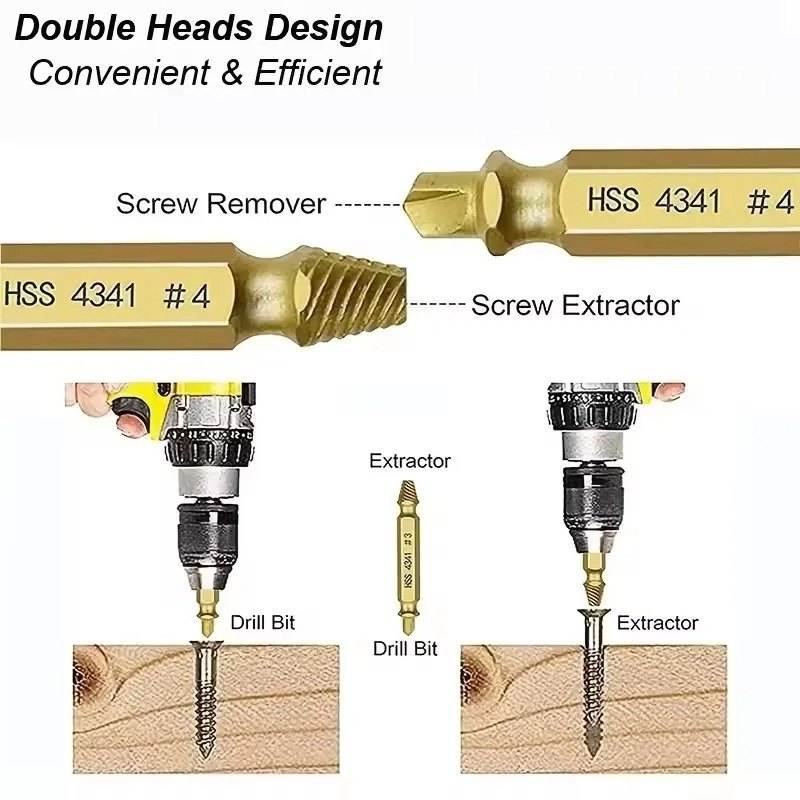
One end is a burr that cuts a cone into the screw head, the other is a short left-hand thread. Both work with the drill in reverse: cut the seat, flip the bit, back the screw out. They're the quickest option for everyday stripped screws, because there's no separate drilling, and they sit on a hex shank that fits any drill or driver.
Limits: they're made for screws, not big seized bolts, and the threaded end is short, so they need some head or shank to bite into. This is the kind we sell.
Spiral extractors (easy outs)
The classic tool: a tapered, left-hand spiral with a square end. You drill a pilot hole into the broken bolt, tap the extractor in, and turn it anticlockwise with a tap wrench. Good for broken bolts and studs that have no head left.
Watch out: the taper acts as a wedge, so it can expand the bolt slightly and lock it tighter in its hole. They're hard and brittle, and a snapped easy out is far worse than the bolt you started with. Go slowly, and stop if it won't turn.
Straight-flute and multi-spline extractors
These have straight ridges instead of a spiral. You hammer them into a pilot hole and turn them with a spanner or socket. Because they don't wedge the way a spiral does, they're the better choice for larger bolts that are really stuck.
Left-hand drill bits
Drill bits that cut anticlockwise. Used in reverse to drill the pilot hole for an extractor, they often catch the broken screw and spin it out on their own. Worth having if you deal with broken screws often.
Bolt extractor sockets
Sockets with spiral teeth inside. You hammer one over a rounded hex bolt head or nut and turn it with a ratchet, and the teeth bite harder as you turn. They're for heads you can get around the outside of, not for screw recesses.
Which one do you need?
- A stripped or rounded screw head (Phillips, Torx, hex): a double-ended extractor bit.
- A rusted screw that's started to round off: a double-ended bit, after penetrating oil (see how to remove a rusted screw).
- A bolt snapped off with no head: a left-hand drill bit, then a spiral or straight-flute extractor.
- A rounded hex bolt head or nut: a bolt extractor socket.
- Tiny screws in a laptop, phone or glasses: a precision kit.
What to look for in a set
- A size range that matches your screws. Most household jobs fall between 3 and 8 mm. Check the size chart.
- Hard steel. High-speed steel (HSS) handles ordinary screws. Very hard bolts need cobalt or carbide tools.
- A hex shank if you'll use a drill or driver, so it doesn't slip in the chuck.
- A case. You'll need these once or twice a year, and they need to be where you left them.
Questions
What is an easy out?
Easy out is the common name for a screw extractor, from an old brand name. It usually means the tapered spiral type that needs a pilot hole drilled first.
What's the difference between a screw extractor and a bolt extractor?
A screw extractor goes into the screw from the centre. A bolt extractor socket goes over the outside of a rounded hex head or nut. Use whichever fits the part you can get to.
Are double-ended screw extractors any good?
For everyday stripped, rounded and rusted screws they're the quickest tool, because the burr end cuts its own seat. For big broken bolts, a pilot hole and a straight-flute or spiral extractor is better.
More guides
- How to remove a stripped screwSeven ways to get it out, from a rubber band to an extractor, in the order to try them.
- How to use a screw extractorPicking the size, which way to turn, drill speed, and the mistakes that snap bits.
- Screw extractor size chartWhich extractor for which screw, in millimetres, Australian gauges and metric bolts.
- How to remove a rusted screwPenetrating oil, shock, heat and an extractor, in the order that works.
- How to remove a broken screwSnapped above, flush or below the surface: what to do for each.